How to Create A Meaningful Tagline
What's the definition of a slogan or tagline? Wikipedia says, "A tagline is a variation on a branding slogan, often used in advertising and marketing materials. The concept behind a slogan or tagline is to develop a memorable phrase that sums up the premise and tone of a product, service or company, or to reinforce an audience's recall of a product. Some slogans are successful enough to become a part of pop culture."
Is That A Good Answer To The Question?
The “sums up the premise and tone" portion works, because your slogan or tagline should convey the essence of your brand – what differentiates you from the competition, why you are better – in a succinct manner. You could call it your Unique Selling Proposition, or USP, boiled down to a few carefully chosen key words.
Is a tagline different than a slogan? Most would consider them one in the same. Consumers most often call them slogans, fondly remembering things like "Where's the beef?" and "Melts in your mouth, not in your hands," etc.
Getting Down to the True Brand Essence
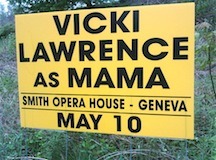
The lawn sign shown here promoting an appearance by Vicki Lawrence is an excellent example of winnowing a message down to exactly and only what needs to be communicated. What do you take away from this sign? First, Ms. Lawrence will be in Geneva at the Smith Opera House on the tenth of May. She will, in some way, be performing her well known character from the Carol Burnett Show, "Mama." I summed up the message in a lot of words. The sign did the same thing, in just nine words. That's the sort of effective, pithy communication that should be in your tagline.
How Do You Determine Your Brand Essence?
Here's an exercise. To start, your "strapline" (as they are known in Australia and England) doesn't need to describe what you do. Look at your overall brand identity in terms of a web site. When someone clicks on your URL, she or he needs to instantly know who you are (a name); what is it that you do or are (product, service or company); and what makes you different and better. The who and what aspects are often covered by your name and accompanying descriptor.
As an example, let's take Cogswell Cookies and Cakes as an example. Immediately, I understand that the company's name is Cogswell, and that they make cookies and cakes. So if your name is Arlen Brothers, make sure you use a descriptor, such as Arlen Brothers Cakes and Cookies. Doing so means that you don't have to make your tag line or slogan work overtime, communicating both what you do AND why you are different and better.
Next step: create a list of phrases and words that are essential to what you do, provide or make – focusing on what is important to communicate and what differentiates you from the competition. Staying with cookies, these might include all organic ingredients, no artificial sweeteners, everything made from scratch, custom creations, one-of-a-kind cakes, etc.
Analyze your list and toss out the parity factors. If enough competitors also don't use artificial sweeteners, this may not be an aspect you wish to promote. It could be "table stakes," as they used to say in poker.
Once you know what you do that they don't, work with your differentiators to create a slogan that sets you apart and conveys your specialness and the value of this to your target audience. In this instance, it could be something like: Cogswell Cookies and Cakes: "Naturally unique. Amazingly delicious."
Be Exactly Like No One Else
A superior, honest, smart branding strategy is to ensure that your messaging is exactly like no one else's. Ponder what really makes you better and different, the uniqueness. If the #1 sprinkler company in the world says "Sprinkler Technology Excellence That Covers the World," using a slogan for your sprinkler business like "A World of Great Sprinklers" will not differentiate your company nearly as much as something that focuses on your USP, such as "More coverage, less water."
Instead of Bragging About How Wonderful You Are, Communicate Your Consumer Benefits
RE/MAX’s slogan is “Nobody in the world sells more real estate than RE/MAX.” OK, good for you RE/MAX, but what's in it for me. This boasting doesn't deliver a benefit to the consumer. RE/MAX is counting on me to take a drive and discover the buried advantage for myself. "Hmmm, if they sell more real estate, I guess it would make sense that they'd be the best ones to sell my home."
How about a tagline that says, "Nobody in the world sells more real estate like yours than RE/MAX." Now that's an improvement, because it personalizes the message and makes it relevant to me.
Instead of boasting about fabulous or big you are, remember that (like Mom said), you only get once chance to make a great first impression. Let's say you meet a guy at a party and the first words out of his mouth are, "I was quarterback at Harvard when we won the Ivy League three years in a row," what is your first impression of him? Now, you meet the same guy and he says, "That is a fabulous necklace. I'd love to get one just like it for my mom. Where did you get that?" How has your first impression been altered? When, like our quarterback friend, you focus on what's in it for the customer – the benefits of what you do as opposed to how great thou art – you will make a much better impression and make that prospect care much more about what you are offering. Because now, he or she knows what's in it and valuable for them.
How Many Words In a Slogan Is Too Many?
Recent slogan trends have veered toward the pithy and succinct. The shorter the better is the thought. "I'm Lovin' It." "Turn Here." "Got Milk?" "Just Do It!"
However, think about this: besides "Got Milk?," couldn't many of the other taglines apply to a variety of products and brands in multiple industries? A chain of shoe stores could say, "I'm Lovin' It" in reference to the great array of styles offered and wonderful fit of their shoes.
Ad slogans such as these lack specificity and the critical details that can make a phrase resonate powerfully and connect in a meaningful way with the target audience.
When you consider "What happens in Vegas stays in Vegas," "15 minutes can save you 15 percent or more on car insurance," and "The night time, sniffing, sneezing, coughing, aching, best-sleep-you-ever got- with-a-cold medicine," the addition of more words and specific, key, descriptive, powerful words makes a world of difference and communicates far more effectively.
Geico tells you about the value of saving money in a completely literal way: take a few minutes and gain significant savings. If they simply said, “Pay less with Geico,” there would not be the same depth of meaning or essential communication. Credibility is conveyed via specifics.
Then think about the Las Vegas brand positioning. It's not lengthy, but it's almost like their slogan conjures up a short story in your mind of wonderful and wild ideas. And they accomplished this in only seven words.
The message: don't get hung up on some mandatory guideline such as "Our slogan must be four words or shorter." Those fifth, sixth and seventh words might be exactly the ones needed to forge an emotional connection and bond with your audience, and create the true resonant, congruent differentiation that shouts why you are really different and better. You want your slogan to be meaningful, and if it takes one or two more words, don't seat it.
Bottom line: if your tagline / slogan can be meaningful and differentiating, differentiated, you gain an edge on your competition. And if you're interested in creating a memorable name and brand or meaningful tagline, please get in touch and let me create an ideal slogan for you, your company, product, or service.
Contact Chuck
Branding, copywriting, voice talent. I'm ready to help you with effective creativity to enhance your image and bottom line.
Phone
585-746-2320
chucketal13@gmail.com